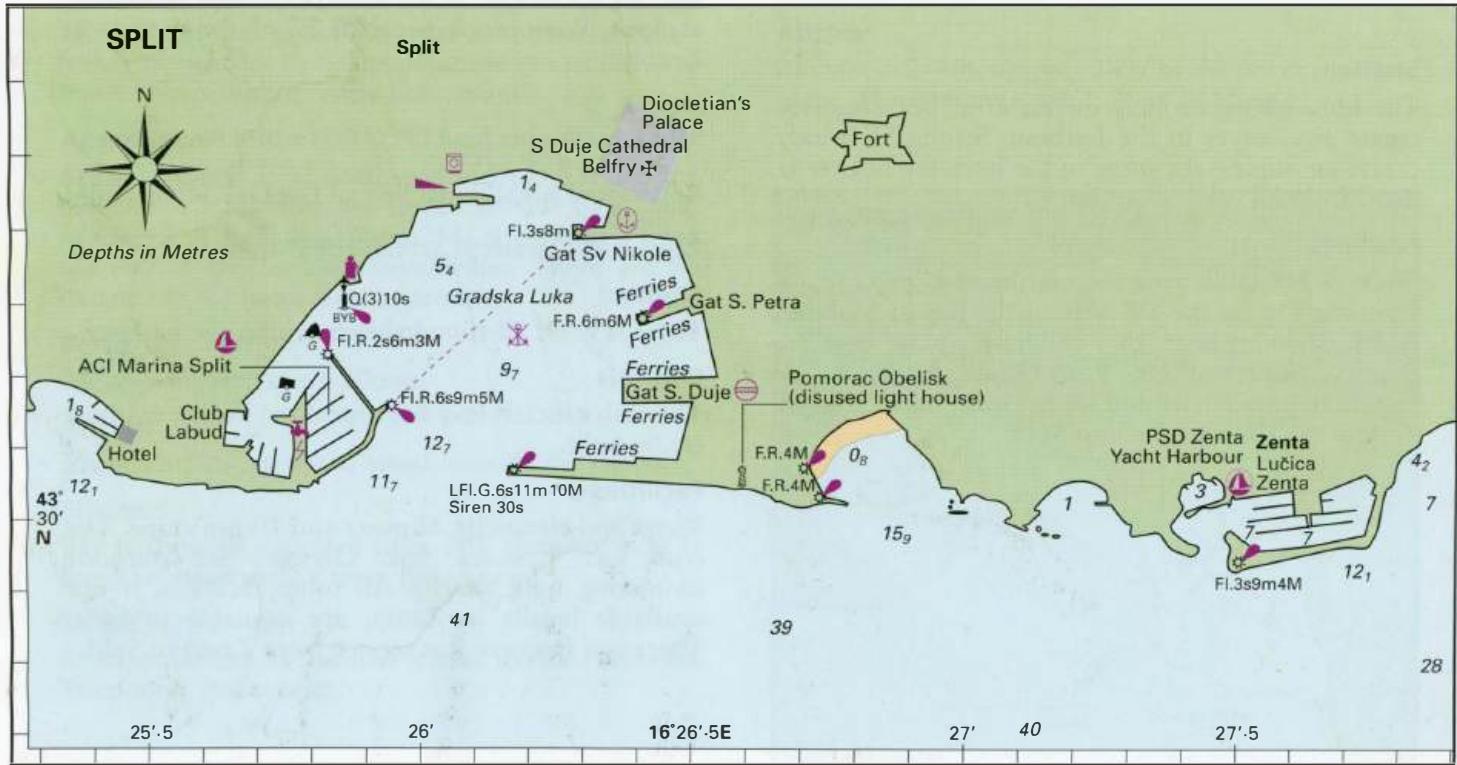
Split
General
43°30'.3N 16°26'-4E Charts BA 2712, 269 (plan), SC 5767, MK 76, 18, lmray M26 As well as being a major administrative and commercial centre, Split is also a tourist centre. Every year it attracts thousands of tourists who come to see its historic monuments and to attend its cultural events. Many tourists also pass through the city en route for other holiday destinations. It is a fabulous city, well worth visiting! The city of Split is built within and around the fortified Roman palace, which was constructed for the Roman Emperor Diocletian in about AD300. Much of the palace still stands today, and it is a unique example of late Roman architecture. The earliest settlement in the area was at Salona (present-day Solin) near the E end of the Kastelanski Zaljev. The Emperor Diocletian, who was born at Salona, decided to have a palace built for him on what was to become the site of Split. The palace was built as a combination between a Roman country villa and a garrison, with an aqueduct bringing water in from the upper reaches of the river Jadro. This aqueduct is apparently still in use, and can be seen near the main Split to Solin road. In the centre of the palace, Diocletian ordered the construction of his mausoleum, where he was buried in due course. After Diocletian's death, the palace gave refuge to exiled Roman emperors and their families for a while before being abandoned. The palace was occupied again in 614 when the inhabitants of Salona fled from the Avars and Slavs who sacked their town. The new residents of the palace converted Diocletian's mausoleum into their (Christian) cathedral, throwing out Diocletian's sarcophagus, and installing in its stead the bones of early martyrs. Ironically, these saints had been executed on Diocletian's orders in AD304. The town of Split grew, soon becoming an important and independent centre. Later Split came under the jurisdiction of the Croatian kings, but still managed to preserve a certain amount of autonomy. In 1420 Venice gained control of Split. Venetian control lasted until the collapse of the Republic of Venice in 1797. The city, together with the whole of Dalmatia, became part of the Austro-Hungarian Empire until 1918, with a brief period under Napoleon at the beginning of the 19th century. Although the city was badly damaged by air raids during the second world war there are still many fine buildings, churches and museums which are worth visiting. Parts of Diocletian's palace still exist, and his mausoleum, still the city cathedral, is little altered from its original condition. Amongst its museums, Split has a nautical museum housed in the early baroque Milesi Palace. It is also possible to visit the ruins of Salona. The large natural town harbour of Split is busy with a constant stream of ferries and ships. The harbour is easy to enter in all conditions and has good facilities for yachts, at the ACI Marina Split on the SW side of the harbour. The marina can be busy at weekends with charter boats, so it is advisable either to arrive early if you want to be sure of a berth, or avoid arriving on a Friday or Saturday.
Approach
From seaward the city of Split is unmistakable. The tall obelisk-like lighthouse (now disused) at Pomorac just to the E of the entrance is a good mark to steer for until you can see the entrance itself. There are no dangers in the approach apart from isolated rocks close inshore on either side of the entrance, and some unlit buoys S of the E breakwater. Beware of ferries and other vessels entering and leaving the harbour. There are usually several ships at anchor outside the harbour.
Lights
E breakwater LFl.G.6sllm10M Siren 30s 285°-vis-253° There is also a buoy with a Fl.G light W of the E breakwater head, which is not shown on the Admiralty chart. Rt Sustipan W breakwater head Fl.R.6s9m5M 139°-vis-020° Inner breakwater Fl.R.2s6m3M 016°-vis-312° (not working in Dec 1998) Gat Sv Nikole Fl.3s8m4M Gat Sv Petra head F.R.6m6M Rt Bacvice F.R.4M (Front light of Ldg Lts 334° marking pipeline)
Berth
There are several arrangements for berthing in Split.
Shelter
The harbour is exposed to winds and swell from S and SW. There is also a constant surge caused by waterborne traffic. The marina, however, offers good all-round shelter.
Officials
Year-round port of entry. The harbour office is in the building with the green cupola near Gat Sv Nikole, Split, with Club Labud on the left-hand side and the ACI marina to the right Split The spacious harbour of Split, looking across the marina towards Diocletian's palace, which now contains the old walled city The fuel berth in Split with Diocletian's palace and the cathedral in the background the pier in the NE corner of the harbour. The customs office is in the big building on the international ferry quay, on the SE side of the harbour. Police.
Facilities
Water is available from the marina or by standpipe from the public quays. Enquire at the harbour office. Petrol and diesel are available (between 0600 and midnight) from the quayside filling station on the NW side of the harbour, near the marina. ore that there are rocks close inshore on either side of the fuel quay. Paraffin is available from hardware stores. Gas bottles can be refilled at the INA-Plin depot at Kastel Sucurac (K. Sucurac, Partizanski put). Alternatively, the marina can arrange for gas bottles to be refilled. Toilets, showers, restaurant, currency exchange office, laundry facilities at the marina. There is a coin operated launderette at Sperun 1 (behind the church of Sv. Frane, on the N side of the harbour). It is open between 0800 and 2000. Service washes cost 75 kuna a load, self service 50 kuna (2006). There is an excellent range of food shops and supermarkets in Split as well as daily markets selling fish, and fruit and vegetables. Other shops include several chandlers near the harbour, hardware shops, photographic shops, department stores, etc. Banks, ATMs, Post Offices, telephones, internet cafe. Doctors, dentists, hospitals, pharmacies, veterinary surgeon. Tourist information. Hotels, restaurants and cafe/bars. British, Danish, Dutch, Finnish, German, Italian, Slovenian, Spanish and Swedish Consulates. Repairs to engines, and electrical/electronic installations can be carried out, and spare parts are available. Croatian charts can be purchased at the harbour office. The marina has a 10-ton crane and a 30-ton travel-hoist. Sailmakers and other repair facilities are located in the building near the Labud yacht club pontoons. Split has an international airport located at the W end of the Kastelanski Zaljev, near Trogir. Croatia Airlines operates a bus to and from the airport. Enquire at the Croatia Airlines office in the town for details. Bus service from outside the marina into town. Split bus and railway stations are on the E side of the harbour, near the ferry berths. Ferries to other Croatian islands and ports, as well as to Italy and Greece. Car hire. Taxis. The marina address is: ACI Marina Split, 21000 Split, Uva la Baluni bb, Croatia 'fi' (021) 398 548 or 398 599 Fax (021) 398 556 Email [email protected] KASTELANSKI ZALJEV The Kastelanski Zaljev is a large landlocked bay to the W of Split, entered between Rt Marjan to the N and Rt Ciovo to the S. The bay acquired its name from the seven fortified settlements along its N shore. From Split westwards these are Kastel Sucurac, Kastel Gomilica, Kastel Kambelovac, Kastel Luksic, Kastel Stari, Kastel Novi and Kastel Stafilic. Some of these coastal settlements have harbours where it is possible for a yacht to berth. A new marina has been built at Kastel Gomilica (to the E of the castle). Rt Marjan On the tip of this headland there is a small private harbour, used by the Oceanographic Institute. The Oceanographic Institute, which is based in the large building near the harbour, has a museum, open to the public. Between Rt Marjan and the sailing club marinas at Spinut to the E the shore is rocky with pine woods. This is a popular bathing area. It is possible to anchor off this shore for lunch. The bottom is mud, and offers good holding. Spinut yacht harbours
Adriatic Navigation Guide Images for Split
Adriatic Navigation Guide images and captions provide additional visual reference for this navigation location.