Region: North Adriatic
| Position: 44.693333, 14.396667 | Adriatic Sea / Jadransko more
44°41'.6N 14°23'.8E Charts BA 202, MK 6, 8, lmray M24 The small, atmospheric town of Osor, surrounded by its Roman and Venetian town walls, is well worth visiting. It has some remarkable sculptures on the theme of music dotted around its streets and in the cathedral square, and during the summer hosts a musical festival. Osor lies at the point wher
General
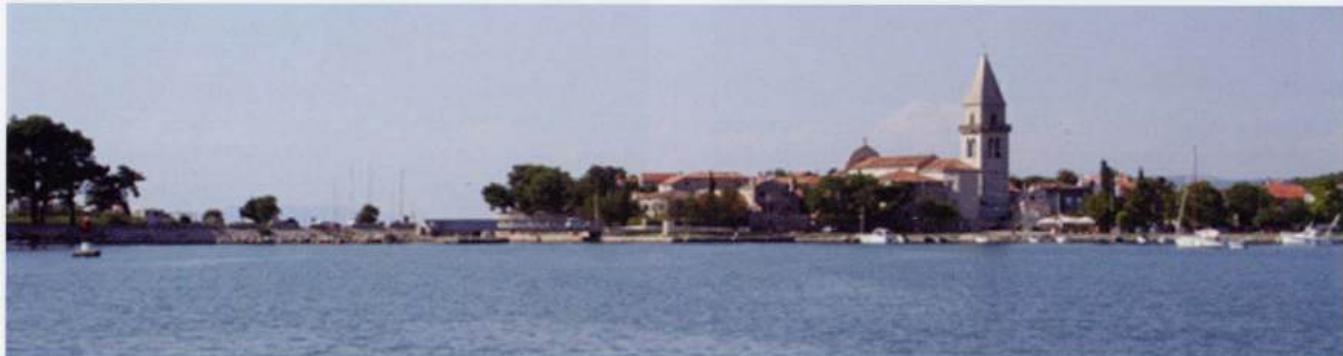
44°41'.6N 14°23'.8E Charts BA 202, MK 6, 8, lmray M24 The small, atmospheric town of Osor, surrounded by its Roman and Venetian town walls, is well worth visiting. It has some remarkable sculptures on the theme of music dotted around its streets and in the cathedral square, and during the summer hosts a musical festival. Osor lies at the point where the islands of Cres and Losinj are only separated by a narrow canal, crossed by a low road bridge. The swing bridge opens twice a day, at 0900 and 1700 hours only.
Approach
Approach is not recommmended in a strong bora or sirocco, since they both create big seas and difficult conditions. From N Entering the Osorski Zaljev (the large bay to the N of Osor), beware of the rocks near Rt Osor, the headland on the W side of the entrance to the bay. An unlit N cardinal beacon, off Rt Osor, marks a rock with just 1 .8m over it. 4 cables to the E, Hrid Skoljic is a rocky islet with a reef on its E side. These dangers lie in the obscured sector of the light in Bijar. Closer to Osor there is a shoal area with 2.4m over it extending 1 cable off the W shore, just SE of Rt Bok. It is possible to tie up in the canal while waiting for the bridge to open, but the currents can run swiftly here (up to 6kns). The safer option, however, is to tie up alongside the quay with the Fl.R. l .5s light as shown on the plan. From S Losinjski Kanal, the channel between Otok Losinj and the S part of Otok Cres, narrows from Rt Seka northwards. The passage to Osor is marked by beacons on the W (Losinj ) side of the channel as shown on the plan. The minimum depth in the channel is 2m. Beware of strong and irregular currents in this area. They can reach up to 6kns, especially through the canal. The canal at Osor is 6m wide, and 2.5m deep. The road bridge opens at 0900 and 1700 hours only to allow the passage of yachts. There is no charge for this service. Vessels coming from S have priority. The bridge attendant, who wears a fluorescent jacket, signals to vessels waiting to the N of the canal when it is clear for them to proceed. When the bridge is
Lights
Northern entrance point to Uvala Bijar Fl.R.3s6rn4M Osor quay Fl.R.1.5s6m3M There are no navigational lights marking the S approach channel.
Berth
It is possible to anchor and take a line ashore in Uvala Bijar, a small bay of Osor. Depths in the bay are too deep and shelving for a yacht to lie to an anchor alone. The N entrance point of this bay is marked by a light (Fl.R.3s). Do not approach this headland too closely because of a rocky spit extending from it. It is possible to tie up alongside the quay of the entrance to the canal. There are depths in excess of 3m here. S of the canal it is possible to anchor at the edge of the channel, or anchor and take a line to the hauling off post shown on the plan. Shallowdraught vessels can tie up bow/stern-to the quay to the E of the canal if space allows.
Shelter
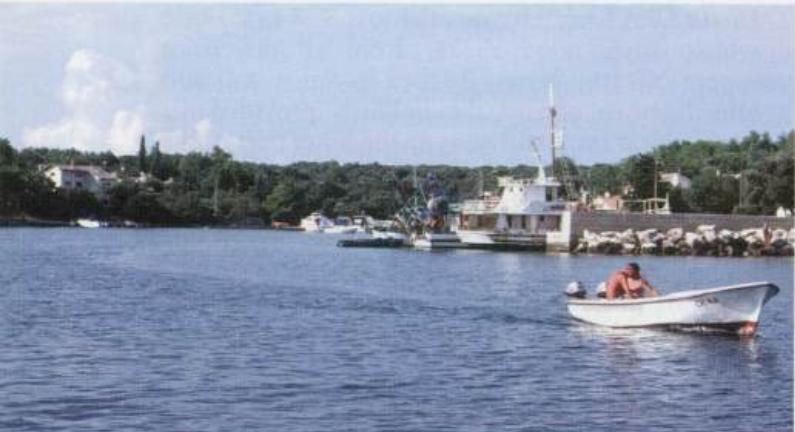
Uvala Bijar is sheltered from all wind directions. The quay on the N side of the canal is exposed to winds from N and NW. The berths to the S of the canal are exposed to winds and sea from SE. It is possible to moor alongside the quay north of the entrance to the canal at Osor Approach to Osor from North
Facilities
Public water tap on roadside. Grocery store, fresh fruit and vegetables from local people, Post Office, several restaurants, campsite. The nearest fuel is available from a fuel berth just N of Nerezine, in the southern approaches to Osor. Bus service to Cres, Mali Losinj, and Rijeka on the mainland.
History
Osor was already an important port before the Romans arrived. It is now believed that the canal was built by the Liburni, an Illyrian tribe, and not the Romans. During the Roman Empire Osor was the second largest city (after Pula) on the E Adriatic coast. After the collapse of the Roman Empire, Osor retained its importance, and was the administrative centre for Cres and Losinj. It started to decline in the 15th and 16th centuries when the construction of larger ships meant that its port was too shallow for them to use. There are a number of interesting sights in Osor, including parts of the Roman city walls and other Roman remains, the cathedral, the town hall, which now houses the museum, the bishop's palace, and the church of Sveti Gaudencije. Gaudencije was born at Osor and was bishop between 1018 and 1042. It was believed by some that Gaudencije was responsible for ridding the islands of poisonous snakes, and a tradition grew up for local sailors to carry a piece of Cres stone to protect them from poisonous snakes on their voyages. Ustrinska Luka
Adriatic Navigation Guide Images for Osor
Adriatic Navigation Guide images and captions provide additional visual reference for this navigation location.