Jezera (Murter): Beaches and Coves, Croatia
About this beach
Jezera (Murter): beaches and coves
Beach character
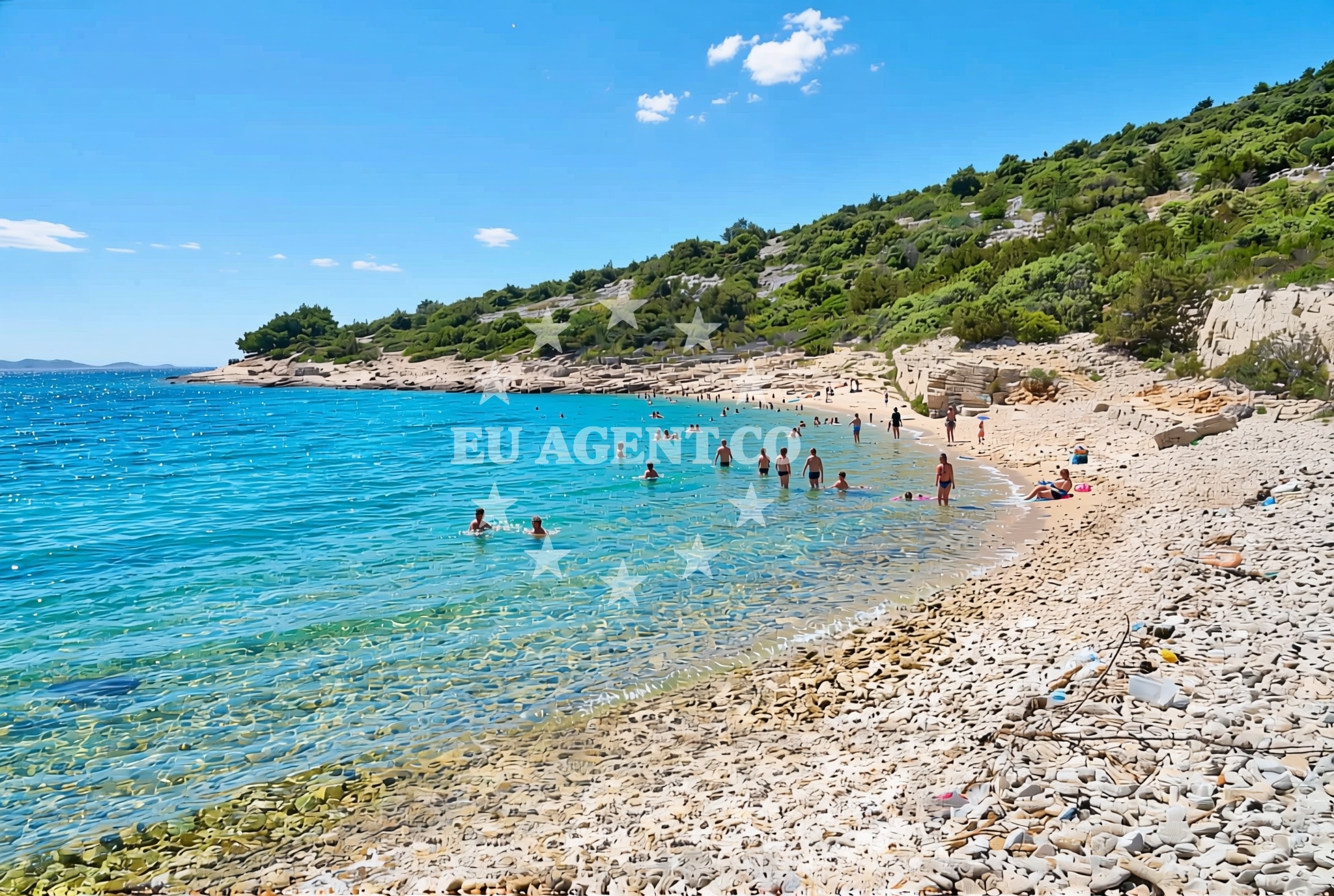
The beaches and coves of Jezera are characterized by their natural, undeveloped shoreline. The area features a mix of pebbled and sandy stretches, often nestled between rocky outcrops and dense vegetation. The waters here are typically calm, with visibility extending to the seabed in shallower areas. These coves are part of a larger network of coastal inlets along Murter, which are popular with swimmers, snorkelers, and kayakers seeking solitude away from more crowded shores.Swimming and shore
Swimming conditions at Jezera’s coves are generally favorable, with water temperatures warming significantly during the summer months. The shorelines vary from sandy patches near the island’s western end to more rugged, pebbled areas toward the eastern coast. While there are no designated swimming zones or lifeguard services, the absence of large crowds makes these beaches ideal for those seeking a quiet, natural setting. Snorkeling is possible in shallower areas, where marine life such as sea urchins and occasional fish species can be observed.Facilities and activities
There are no formal facilities at Jezera’s beaches, such as changing rooms, showers, or parking. However, nearby villages like Tisno and the mainland connection via the Murter Bridge offer services for visitors. Activities centered around the area include hiking along the island’s coastal trails, cycling through Murter’s vineyards, and exploring the island’s historic sites, such as the 14th-century fortress of Fortica. The coves themselves are well-suited for kayaking and stand-up paddleboarding, with calm waters and sheltered bays.Access and location
Jezera is accessible by car via the Murter Bridge, which connects the island to the mainland near Tisno. The beach’s location on the island’s southern coast places it within reach of other notable sites, including the village of Primošten and the nearby island of Prvić. For yacht charter guests, the surrounding waters are part of a larger sailing area that includes the Kornati National Park and the islands of Hvar and Brac. The nearest marinas are in Tisno and the mainland port of Sibenik, both of which offer provisioning and maintenance services.What to expect
Visitors to Jezera’s beaches should expect a natural, low-key environment with minimal infrastructure. The coves are best suited for those who prefer solitude and unspoiled scenery over commercial amenities. The area’s appeal lies in its integration with the broader Murter landscape, where visitors can combine beach time with explorations of the island’s cultural and natural heritage. Due to the lack of formal facilities, it is advisable to bring personal supplies such as water, sunscreen, and snacks.Practical tips
For those visiting Jezera’s beaches, consider arriving early to secure a spot on the more sheltered coves. The rocky terrain near the shoreline may require sturdy footwear for access. Given the absence of nearby services, it is recommended to plan meals and refreshments in advance, particularly for multi-day stays or extended exploration of the area.Exploring the coast by yacht
For yacht charter guests, the waters around Jezera and Murter offer a mix of coastal sailing and open-sea routes. The island’s position near the Kornati archipelago makes it a convenient base for exploring the region’s famous limestone islands and marine reserves. Anchorages are available in nearby bays, and the proximity to Tisno ensures access to marinas, fuel stations, and provisioning options. The sailing area is particularly appealing during the shoulder seasons, when the waters are less crowded and the coastal scenery is at its most vivid.Historical and Cultural Context
Murter’s history is deeply tied to its maritime traditions, with fishing and shipbuilding playing key roles in the island’s economy. The fortress of Fortica, located near the island’s northern end, is a reminder of the region’s strategic importance during the medieval period. Local villages retain traditional architecture, with stone houses and narrow streets that reflect centuries of island life.Anchorages in the surrounding area
Anchorages in the surrounding area, including Lovišća and Anchorage near Murter.
- Lovišća — lovisca — tisno — 0.9 NM from beach
- Anchorage — murter — 0.9 NM from beach
- Anchorage — murter — 1.6 NM from beach
- Jazina — pirovac — 1.7 NM from beach
- Obinuš — obinus — tisno — 1.9 NM from beach
- Anchorage — pirovac — 2.0 NM from beach
- Anchorage — vodice — 2.0 NM from beach
- Anchorage — murter — 3.3 NM from beach
Distances are straight-line geographic distances, not sailing routes.
Mooring buoys in the surrounding area
Mooring buoys in Tisno, such as Jetty and Quay, located near the beach.
- Jetty — tisno — 0.6 NM from beach
- Quay — tisno — 0.8 NM from beach
- Gina — tisno — 0.9 NM from beach
- Quay — tisno — 1.0 NM from beach
- Apartmani-Restoran-Prova — apartmani restoran prova — tisno — 1.1 NM from beach
Distances are straight-line geographic distances, not sailing routes.
Marine fuel stations
Marine fuel stations in Jezera, Murter, and Tribunj, including Ina and Flash.
- Ina — jezera — murter — 0.1 NM from beach
- Ina — murter — 3.2 NM from beach
- Flash — murter — 3.2 NM from beach
- Petrol — tribunj — 5.0 NM from beach
Distances are straight-line geographic distances, not sailing routes.
Harbours in the surrounding area
Harbours in Murter, Pirovac, and Tribunj, such as Jezera and Marina Pirovac.
- Jezera — murter — 0.2 NM from beach
- Pirovac — 2.0 NM from beach
- Betina — murter — 2.7 NM from beach
- Betina — murter — 2.7 NM from beach
- Tribunj — 4.8 NM from beach
- Vodice — 6.0 NM from beach
Distances are straight-line geographic distances, not sailing routes.
Marinas in the surrounding area
Marinas in Murter and Pirovac, including ACI Marina Jezera and Marina Pirovac.
- ACI Marina Jezera — murter — 0.2 NM from beach
- Marina Pirovac — 2.0 NM from beach
- Marina Betina — murter — 3.1 NM from beach
- Marina Hramina — murter — 3.3 NM from beach
- Marina Tribunj — 4.9 NM from beach
Distances are straight-line geographic distances, not sailing routes.
Restaurants near the beach
Restaurants in Jezera, such as Kandela and Denis, situated near the beach.
- Kandela — jezera — murter — 0.0 NM from beach
- Denis — jezera — murter — 0.0 NM from beach
- Carevi Dvori — jezera — murter — 0.1 NM from beach
- Leut — jezera — murter — 0.1 NM from beach
- Makina — jezera — murter — 0.1 NM from beach
- Lucica — jezera — murter — 0.2 NM from beach
- Marina Restaurant — jezera — murter — 0.2 NM from beach
Distances are straight-line geographic distances, not sailing routes.
Navigation guides for the surrounding area
Navigation guides for nearby locations like Jezera and Pirovac.
- Jezera — 0.3 NM from beach
- Uvala Sv. Nikola — 0.8 NM from beach
- Tijesno (Tisno) — 0.8 NM from beach
- Uvala Gracina — 1.2 NM from beach
- Pirovac — 2.2 NM from beach
Distances are straight-line geographic distances, not sailing routes.
Yachts from nearby departure bases
Yachts departing from bases in Murter, including Murter Jezera Port and Murter ACI Marina Jezera.
Sailing yachts
- Bavaria 44 (Flipper I) — Murter ACI Marina Jezera — 0.2 NM from departure base to beach
- First 35 (Taurus) — Murter ACI Marina Jezera — 0.2 NM from departure base to beach
- Dehler 38 SQ (Blue Eye) — Murter ACI Marina Jezera — 0.2 NM from departure base to beach
- Elan 450 (Eviva I) — Murter ACI Marina Jezera — 0.2 NM from departure base to beach
- Elan 344 Impression (Vita I) — Murter ACI Marina Jezera — 0.2 NM from departure base to beach
- Oceanis 51.1 (Pisces) — Murter ACI Marina Jezera — 0.2 NM from departure base to beach
- Elan 50 Impression (Suzy) — Murter ACI Marina Jezera — 0.2 NM from departure base to beach
Catamarans
- Lagoon 410 S2 (Dream) — Murter Jezera Port — 0.1 NM from departure base to beach
Motor boats
- Damor 980 Fjera (Neja) — Murter ACI Marina Jezera — 0.2 NM from departure base to beach
- Damor 980 Fjera (Neja) — Murter ACI Marina Jezera — 0.2 NM from departure base to beach
Distances are straight-line geographic distances, not sailing routes.