Fujaga, Vrsar Beach, Croatia
Fujaga, Vrsar Beach lies along the rugged coastline of Vrsar, a town on Croatia’s Istrian Peninsula. This shoreline is defined by its gravel, concrete slabs, and rocky terrain, offering a distinct contrast to the region’s more common sandy beaches. At 160 meters in length, it is a modest stretch of coast, but its presence in Vrsar—a historic Adriatic settlement—connects it to the broader narrative of Istria’s maritime heritage. The beach includes a shower facility, a practical detail for visitors seeking comfort after exploring the nearby rocky shore.
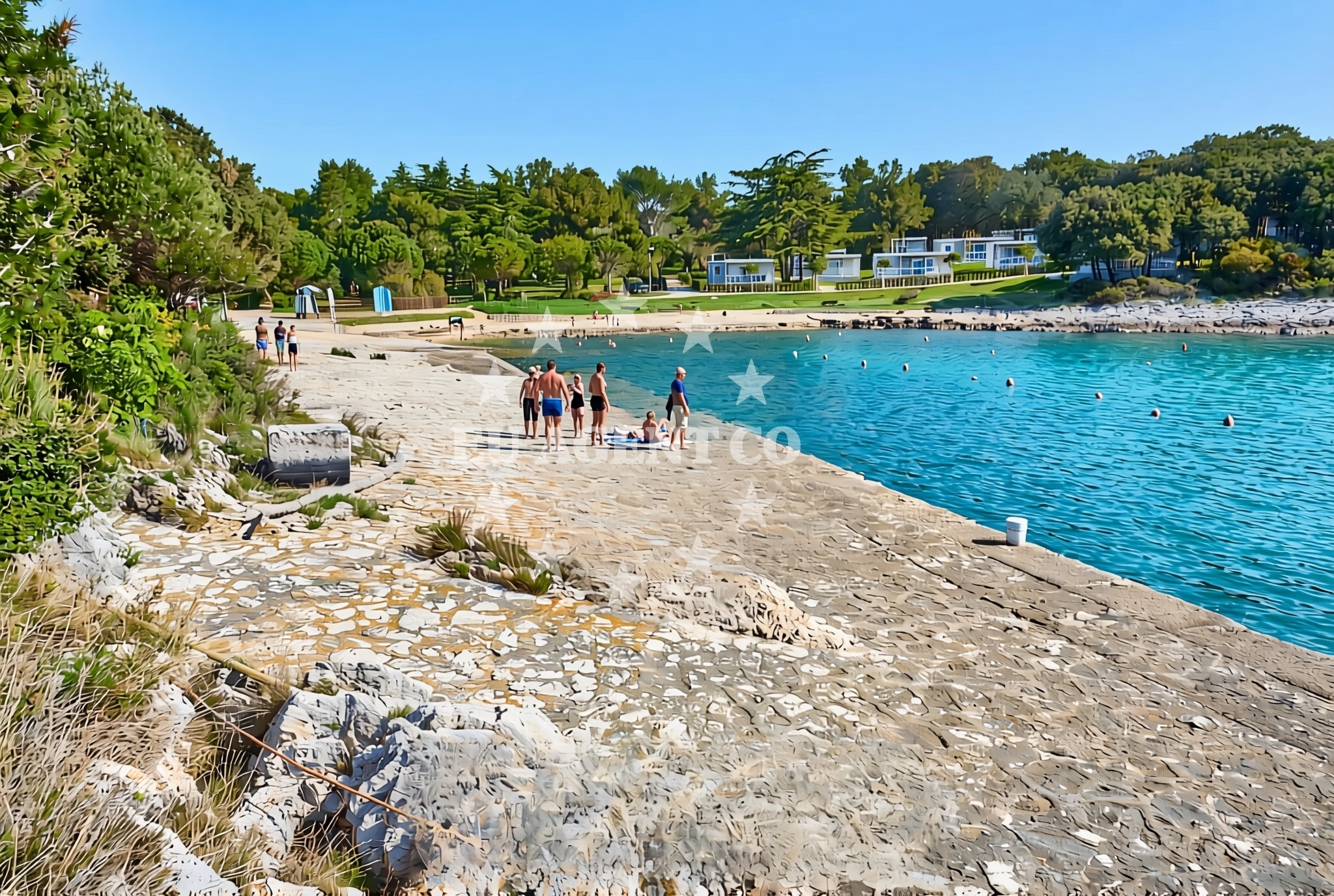
About this beach
Fujaga, Vrsar
Beach: Fujaga
Location: Vrsar
Characteristics and facilities
Gravel, concrete / stone slabs, rocks
160 m
shower
Beach character
The beach’s surface is a mix of gravel, concrete slabs, and natural rock formations, creating a terrain that is more suited to casual strolls than sunbathing. This composition reflects the geological character of the Istrian coastline, where limestone and marine sediments shape the shore. The 160-meter length provides a linear path along the water’s edge, flanked by the same rocky outcrops that define the surrounding landscape. While the lack of sand may deter some visitors, the beach’s raw, unpolished appearance aligns with the natural aesthetics of the region.
Swimming and shore
Swimming conditions at Fujaga are influenced by the rocky shoreline, which may create uneven water depths and limited areas for wading. The shore itself is a continuation of the rugged Istrian coast, where cliffs and boulders dominate. Visitors should be mindful of the terrain when entering the water, as the mix of gravel and rock can make footing unstable. The beach’s proximity to the open Adriatic Sea means that wave action may be more pronounced than in sheltered coves, though the exact conditions depend on seasonal winds and tides.
Facilities and activities
The sole facility explicitly noted at Fujaga is a shower, which is a rare amenity for a beach with no other listed infrastructure. There are no additional services or structures indicated in the beach’s authoritative records. Activities are not specified in the catalog, though the surrounding area of Vrsar offers opportunities for hiking, cycling, and exploring Istria’s vineyards and olive groves. The beach itself appears to be a passive space, best suited for those seeking solitude or a brief stop during a coastal journey.
Access and location
Fujaga, Vrsar Beach is located in Vrsar, a coastal town on the northern coast of Istria, Croatia. The town is accessible via road from Rovinj and Umag, with the Adriatic Sea forming its eastern boundary. Vrsar’s historical significance as a fishing and trading hub is evident in its architecture and maritime traditions. The beach’s coordinates (45.131457° N, 13.612652° E) place it within a region known for its sailing routes, with the Istrian Peninsula’s western coast offering a network of anchorages and marinas for yachts. Visitors arriving by land may find the beach’s access points limited to footpaths or minor roads, typical of smaller coastal settlements.
What to expect
Visitors to Fujaga, Vrsar Beach should expect a shoreline defined by gravel, concrete slabs, and rocks, with no additional amenities beyond a shower facility. The beach’s length of 160 meters provides a modest space for exploration, though its rugged terrain may not appeal to those seeking traditional sandy beaches. The area is best approached as a stopover or a brief visit, with the surrounding Vrsar town offering more developed services. The beach’s connection to the Adriatic Sea means that weather conditions—particularly wind and wave activity—will significantly influence the experience. No structured activities or services are available at the beach itself.
Practical tips
Given the beach’s rocky and gravelly surface, visitors should wear sturdy footwear to avoid discomfort. The shower facility is a notable feature, but no other amenities are available. Those planning to spend time at the beach should bring water and snacks, as there are no nearby vendors. The absence of marked parking or road access suggests that reaching the beach may require walking from the nearest road or settlement.
Exploring the coast by yacht
The Istrian Peninsula, where Vrsar is located, is a well-established sailing region in the Adriatic Sea. Yacht charter companies, including Euro-Agent, operate in the area, offering access to anchorages and marinas along the coast. Fujaga’s proximity to Vrsar means that it could serve as a minor waypoint for sailors exploring the western Istrian coast, though its lack of facilities makes it unsuitable for extended stays. The surrounding waters are part of a larger network of sailing routes that connect to Rovinj, Pula, and the Kvarner Gulf, making it a potentially useful reference point for charters navigating the region.
Vrsar’s Coastal Legacy
Vrsar’s history as a maritime settlement dates back to the 13th century, when it was a key port for the Republic of Venice. Today, the town retains elements of its past through its architecture and cultural festivals. The beach at Fujaga, while modest, reflects the same rugged coastline that has shaped Vrsar’s identity. Nearby, the town’s harbor and marinas continue to serve as hubs for both commercial and recreational vessels, linking the beach to the broader narrative of Istria’s seafaring traditions.
Anchorages in the surrounding area
Anchorages in Rovinj and Funtana offer nearby options for mooring in the surrounding area of Fujaga, Vrsar Beach.
- Anchorage — rovinj — 0.8 NM from beach
- Kriz — rovinj — 0.8 NM from beach
- Anchorage — rovinj — 2.1 NM from beach
- Anchorage — funtana — 2.1 NM from beach
- Anchorage — funtana — 2.4 NM from beach
- Anchorage — rovinj — 2.4 NM from beach
- Anchorage — funtana — 2.9 NM from beach
- Anchorage — rovinj — 3.8 NM from beach
Distances are straight-line geographic distances, not sailing routes.
Mooring buoys in the surrounding area
- Buoy field — rovinj — 0.7 NM from beach
- Buoy field — vrsar — 1.4 NM from beach
- Buoy field — vrsar — 1.5 NM from beach
- Buoy field — funtana — 1.7 NM from beach
- Buoy field — rovinj — 2.0 NM from beach
Distances are straight-line geographic distances, not sailing routes.
Marine fuel stations
Marine fuel stations in Vrsar and Rovinj supply nearby refueling options for vessels visiting Fujaga, Vrsar Beach.
- Crodux — vrsar — 1.1 NM from beach
- Crodux — vrsar — 1.1 NM from beach
- Ina — rovinj — 3.0 NM from beach
- Ina — porec — 5.6 NM from beach
Distances are straight-line geographic distances, not sailing routes.
Harbours in the surrounding area
- Vrsar — 1.2 NM from beach
- Amarin — rovinj — 1.7 NM from beach
- Valkanela — funtana — 1.9 NM from beach
- Funtana — 2.9 NM from beach
- Valdibora — rovinj — 2.9 NM from beach
- Rovinj North Harbour — 3.2 NM from beach
Distances are straight-line geographic distances, not sailing routes.
Marinas in the surrounding area
- Marina Valalta — rovinj — 0.5 NM from beach
- Marina Vrsar — 1.2 NM from beach
- Marina Funtana — 2.8 NM from beach
- ACI Marina Rovinj — 3.5 NM from beach
- Marina Parentium — porec — 4.5 NM from beach
Distances are straight-line geographic distances, not sailing routes.
Restaurants near the beach
Restaurants in Vrsar offer dining options for visitors to Fujaga, Vrsar Beach.
- Konoba Petra — vrsar — 0.6 NM from beach
- Konoba Amor — vrsar — 1.0 NM from beach
- Pizzeria Fancita — vrsar — 1.0 NM from beach
- Dvi Palme — vrsar — 1.1 NM from beach
- Antoni — vrsar — 1.1 NM from beach
- Azzuro — vrsar — 1.1 NM from beach
- Tik-Tak — tik tak — vrsar — 1.1 NM from beach
Distances are straight-line geographic distances, not sailing routes.
Navigation guides for the surrounding area
Navigation guides from Limski Kanai and nearby areas assist in planning routes to Fujaga, Vrsar Beach.
- Limski Kanai — 0.2 NM from beach
- Poree — 5.8 NM from beach
- Luka Crvar and Marina Crvar-Porat — 8.9 NM from beach
- Novi grad — 11.5 NM from beach
Distances are straight-line geographic distances, not sailing routes.
Yachts from nearby departure bases
Yachts departing from Poreč Marina Funtana provide access to Fujaga, Vrsar Beach and surrounding waters.
Sailing yachts
- Bavaria 44 (Franzi) — Poreč Marina Funtana — 2.8 NM from departure base to beach
- Bavaria 49 (Tortola) — Poreč Marina Funtana — 2.8 NM from departure base to beach
- Bavaria 40 Cruiser (Franzi) — Poreč Marina Funtana — 2.8 NM from departure base to beach
- Bavaria 40 (Conny) — Poreč Marina Funtana — 2.8 NM from departure base to beach
- Gib Sea 43 (Leonardo) — Poreč Marina Funtana — 2.8 NM from departure base to beach
- Bavaria 32 (Wally) — Poreč Marina Funtana — 2.8 NM from departure base to beach
- Bavaria 46 Cruiser (Barbados) — Poreč Marina Funtana — 2.8 NM from departure base to beach
- Bavaria 35 Cruiser (Salsa) — Poreč Marina Funtana — 2.8 NM from departure base to beach
- Bavaria 46 Cruiser (Hansi) — Poreč Marina Funtana — 2.8 NM from departure base to beach
Catamarans
- Lagoon Power 44 (Monteki) — Poreč Marina Funtana — 2.8 NM from departure base to beach
Distances are straight-line geographic distances, not sailing routes.