Cvitačka (FKK), Makarska Beach, Croatia
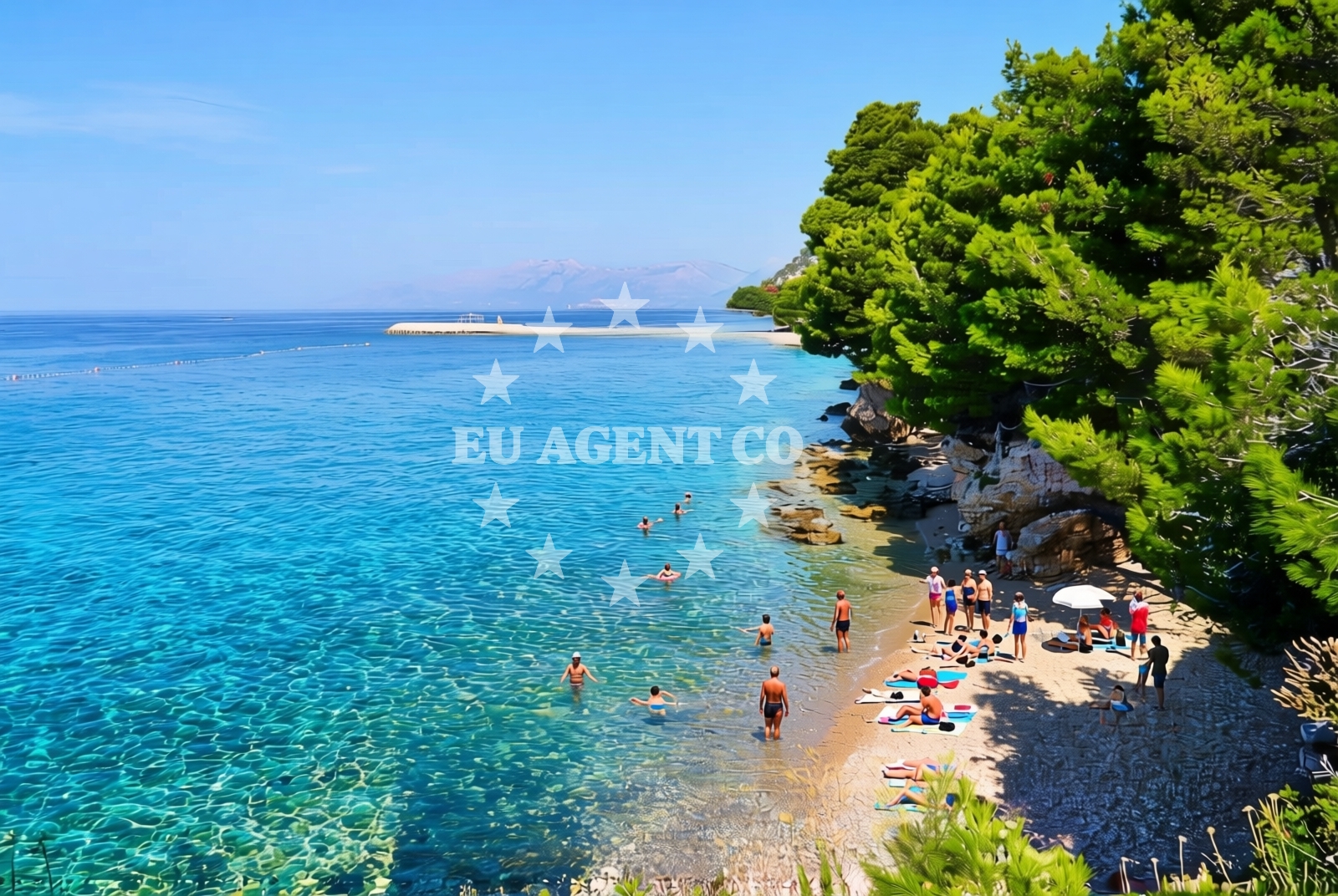
Cvitačka (FKK) Beach is a short, gravelly shoreline located in the coastal town of Makarska on Croatia’s Dalmatian coast. Stretching approximately 200 meters, the beach is characterized by its rocky terrain and natural shade, offering a unique contrast to the more sandy beaches of the region. Situated in the Makarska Riviera, this beach is part of a landscape shaped by the Adriatic Sea’s influence and historic trade routes that once connected the Mediterranean to inland Europe.
About this beach
Cvitačka (FKK), Makarska
Beach: Cvitačka (FKK)
Location: Makarska
Characteristics and facilities
Gravel, rocks
200 m
Natural shade
Beach character
The beach’s composition of gravel and rocks defines its character, making it more suitable for walking or sunbathing in shaded areas than for swimming. Natural shade is provided by nearby rock formations, which create pockets of relief from the sun. The beach’s brevity—just 200 meters in length—means visitors can easily explore its entirety on foot. While it lacks artificial amenities, its raw, unaltered state reflects the natural coastal geography of Makarska, which has been shaped by millennia of erosion and maritime activity.
Swimming and shore
Due to its gravelly and rocky composition, Cvitačka (FKK) is not ideal for swimming. The shoreline’s uneven surface is better suited for leisurely strolls or sitting in the shade. The beach’s proximity to the sea allows for views of the Adriatic, though the water’s depth and clarity near the shore are not specified in available records. For those seeking aquatic activities, nearby beaches in Makarska offer more conventional swimming conditions.
Facilities and activities
No artificial facilities or structured activities are listed for Cvitačka (FKK) Beach. Its appeal lies in its natural features rather than amenities. The absence of marked activities suggests it is not a destination for organized recreation, though its location in Makarska—a town with historic sites like the Fortress of Saint Nicholas—may offer cultural interests to visitors exploring the area.
Access and location
Located in Makarska, a town on the southern Dalmatian coast, Cvitačka (FKK) Beach is accessible via the town’s road network. Makarska itself is a gateway to the broader Makarska Riviera, which extends northward toward the town of Split. The beach’s proximity to the town center means visitors can combine a visit with exploring Makarska’s historic landmarks, cafes, and markets. For those arriving by sea, the nearby port of Makarska serves as a base for yachting excursions along the coast.
What to expect
Visitors to Cvitačka (FKK) Beach should expect a short, gravelly shoreline with natural shade provided by rock formations. The beach is not suited for swimming but offers a quiet, unspoiled coastal experience. Its location in Makarska means it is near the town’s cultural and culinary attractions, though it lacks the amenities of more developed beaches in the region. The beach’s character is defined by its natural state, making it a place for contemplation rather than active recreation.
Practical tips
Wear sturdy footwear to navigate the gravel and rocks comfortably. Bring a towel or mat for sitting in shaded areas. Since the beach lacks facilities, consider bringing water and snacks if planning a prolonged visit. For swimming, explore nearby beaches in Makarska.
Exploring the coast by yacht
The Makarska Riviera, where Cvitačka (FKK) Beach is located, is a popular sailing destination along Croatia’s Dalmatian coast. Yachters often explore this region for its combination of historic sites, clear waters, and sheltered bays. The nearby port of Makarska serves as a common starting point for charter trips, with opportunities to anchor in nearby coves or visit the town’s landmarks. For those interested in yacht charter, the Euro-Agent Yacht Search page provides details on available vessels for exploring the Adriatic.
Historic Context of Makarska
Makarska, the town near Cvitačka (FKK) Beach, has a history dating back to ancient times. It was mentioned in Roman records and later became a key medieval trading hub. The town’s Fortress of Saint Nicholas, built in the 16th century, overlooks the coast and offers panoramic views of the Adriatic. This historic backdrop adds cultural depth to any visit to the area, whether arriving by land or sea.
Anchorages in the surrounding area
- Anchorage — makarska — 1.0 NM from beach
- Anchorage — promajna — 1.8 NM from beach
- Anchorage — sumartin — brac — 4.9 NM from beach
- Anchorage — povlja — brac — 5.9 NM from beach
- Anchorage — povlja — brac — 6.3 NM from beach
- Anchorage — povlja — brac — 6.7 NM from beach
- Anchorage — povlja — brac — 7.1 NM from beach
- Anchorage — povlja — brac — 7.2 NM from beach
Distances are straight-line geographic distances, not sailing routes.
Mooring buoys in the surrounding area
Mooring buoys in Krvavica and Baska Voda provide nearby access points to Cvitačka (FKK) Beach.
- Quay — krvavica — 1.0 NM from beach
- Baško Polje — basko polje — baska voda — 2.8 NM from beach
- Kraj - Soline — kraj soline — drasnice — 7.4 NM from beach
- Konoba Rojen jetty — povlja — brac — 8.9 NM from beach
- Restaurant Pipo jetty — povlja — brac — 9.0 NM from beach
Distances are straight-line geographic distances, not sailing routes.
Marine fuel stations
- Ina — makarska — 1.3 NM from beach
- Fuel station — sumartin — brac — 6.1 NM from beach
- Fuel station — bol — brac — 15.3 NM from beach
- Ina — vrboska — hvar — 16.2 NM from beach
Distances are straight-line geographic distances, not sailing routes.
Harbours in the surrounding area
Harbours in Makarska, Tucepi, and Brela are within short distances of Cvitačka (FKK) Beach.
- Harbour — makarska — 0.7 NM from beach
- Makarska — 1.4 NM from beach
- Tučepi — tucepi — 3.9 NM from beach
- Brela — 4.4 NM from beach
- Podgora — 5.2 NM from beach
- Stomarica — 5.5 NM from beach
Distances are straight-line geographic distances, not sailing routes.
Marinas in the surrounding area
Marinas in Krvavica and Baska Voda are situated near Cvitačka (FKK) Beach.
- Marina Ramova — krvavica — 1.0 NM from beach
- Marina Baška Voda — marina baska voda — 3.6 NM from beach
- Marina Tučepi — marina tucepi — 3.9 NM from beach
- ACI Marina Vrboska — hvar — 16.2 NM from beach
- ACI Marina Korčula — korcula — 22.0 NM from beach
Distances are straight-line geographic distances, not sailing routes.
Restaurants near the beach
Restaurants in Krvavica and Makarska are located close to Cvitačka (FKK) Beach.
- Restaurant Ramova — krvavica — 1.0 NM from beach
- Restoran Ivo — makarska — 1.2 NM from beach
- Restoran King — baska voda — 3.6 NM from beach
- Konoba Feral — brela — 4.4 NM from beach
- Marko — brela — 4.4 NM from beach
Distances are straight-line geographic distances, not sailing routes.
Navigation guides for the surrounding area
Navigation guides for Su Martin, Podgora, and Uvala Studena support travel near Cvitačka (FKK) Beach.
- Su martin — 5.5 NM from beach
- Podgora — 5.5 NM from beach
- Uvala Studena — 7.0 NM from beach
- Uvala Luka — 8.7 NM from beach
- Mi mice — 9.8 NM from beach
Distances are straight-line geographic distances, not sailing routes.
Yachts from nearby departure bases
Yachts departing from Makarska Port and Baška Voda are based near Cvitačka (FKK) Beach.
Sailing yachts
- Oceanis 331 (Aloha) — Baška Voda — 3.6 NM from departure base to beach
- Bavaria Cruiser 37 (Baby Panda) — Baška Voda — 3.6 NM from departure base to beach
- Elan 45 Impression (" MONACO ") — Baška Voda — 3.6 NM from departure base to beach
Catamarans
- Lagoon 450 (LAMANTIN) — Baška Voda — 3.6 NM from departure base to beach
Motor yachts
- Princess V53 (Chablis) — Makarska Port — 1.5 NM from departure base to beach
- Canados 86 (Karisma) — Baška Voda — 3.6 NM from departure base to beach
Motor boats
- Jeanneau NC 37 (Black Pearl) — Makarska Port — 1.5 NM from departure base to beach
- Galeon 430 Skydeck (Bellagio) — Makarska Port — 1.5 NM from departure base to beach
- Jeanneau NC 37 (Black Pearl) — Makarska Port — 1.5 NM from departure base to beach
- Galeon 430 Skydeck (BELLAGIO) — Makarska Port — 1.5 NM from departure base to beach
Distances are straight-line geographic distances, not sailing routes.