Ćurilo, Makarska Beach, Croatia
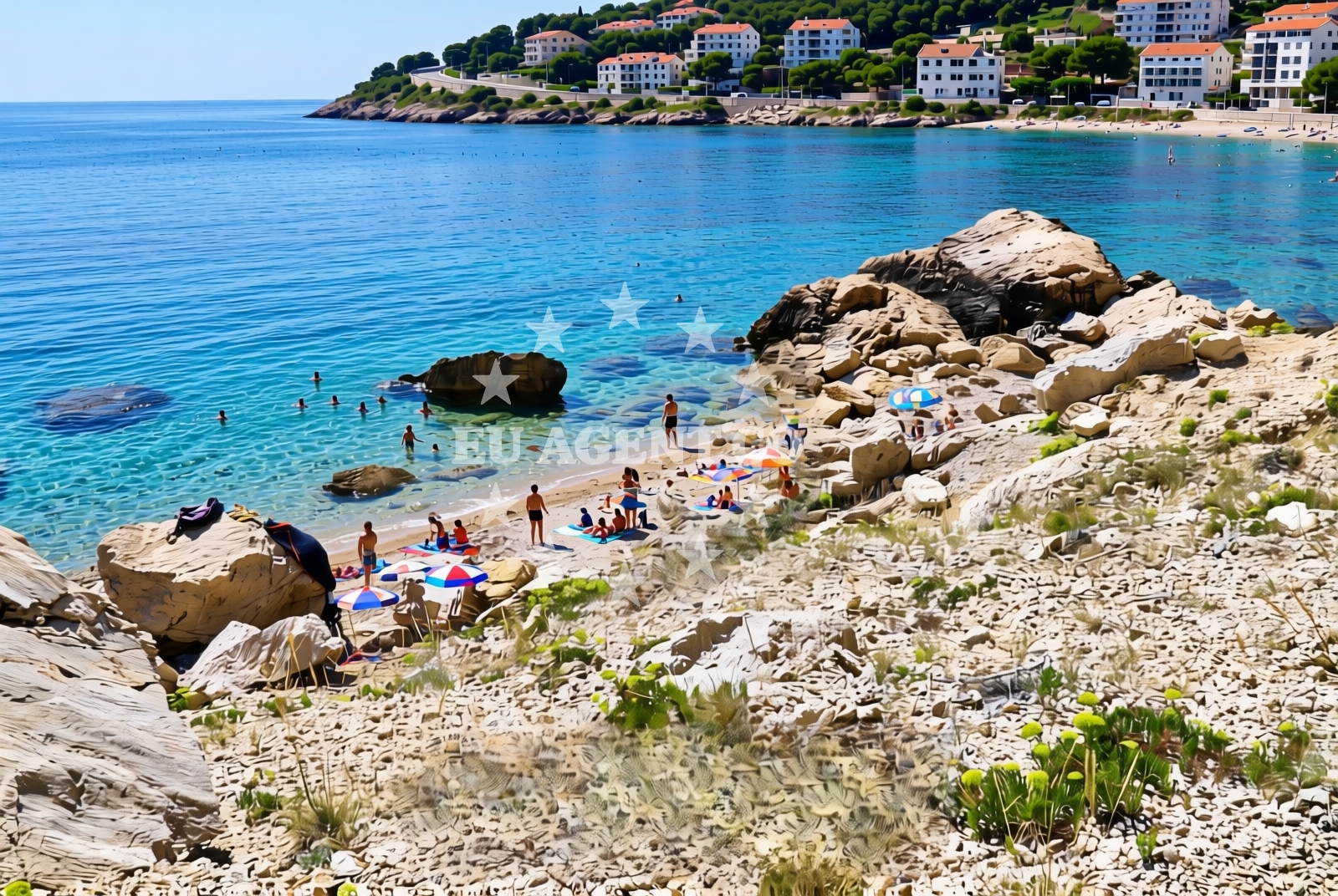
About this beach
Ćurilo, Makarska
Beach: Ćurilo
Location: Makarska
Characteristics and facilities
Gravel, rocks
550 m
Beach character
The beach's composition of gravel and rocks defines its character, offering a stark contrast to the soft sands of nearby shores. This terrain creates a unique environment for visitors seeking a less conventional coastal experience. The rocky outcrops and uneven surface suggest that the beach is better suited for leisurely walks or exploration rather than sunbathing. The beach's length of 550 meters provides ample space to traverse, though the lack of traditional amenities means visitors should prepare for a more rugged setting.Swimming and shore
Swimming conditions at Ćurilo Beach are influenced by the rocky shoreline, which may make direct access to the water challenging in some areas. The Adriatic Sea's clarity is likely evident here, though the gravel and rock substrate may limit the beach's appeal for those seeking calm, shallow waters. The shore itself is defined by its natural contours, with no artificial structures or designated swimming zones. Visitors should be mindful of the terrain when entering the sea.Facilities and activities
The beach lacks formal facilities such as showers, restrooms, or umbrellas. Its natural setting means that activities are limited to walking along the shore, exploring the rocky terrain, or enjoying panoramic views of the coastline. The absence of structured amenities aligns with its character as a more remote and unspoiled stretch of the Dalmatian coast.Access and location
Ćurilo Beach is situated within the town of Makarska, a historic port city on the Adriatic. Access to the beach is likely via local roads connecting to Makarska's central area. The town itself offers a range of cultural and historical attractions, including medieval fortifications and traditional Dalmatian architecture. Visitors arriving by yacht may find the beach's proximity to Makarska's harbor and surrounding marinas advantageous for exploring the region.What to expect
Visitors to Ćurilo Beach should expect a rugged, natural shoreline defined by gravel and rocks. The beach's 550-meter length provides space for exploration, though the lack of traditional amenities means it is best suited for those seeking a more remote coastal experience. The area's proximity to Makarska's historic town and its position along the Dalmatian coast offer opportunities to combine beach visits with cultural and historical exploration.Practical tips
Due to the beach's rocky terrain, visitors are advised to wear sturdy footwear. The absence of formal facilities means that provisions for sun protection, hydration, and waste disposal should be brought along. The beach's location near Makarska's harbor may make it a convenient stop for yacht charter guests exploring the region.Exploring the coast by yacht
For visitors arriving by yacht, Ćurilo Beach's proximity to Makarska's harbor and surrounding marinas offers a strategic base for exploring the Dalmatian coast. The Split-Dalmatia region is a popular sailing destination, with routes extending to nearby islands and coastal towns. Euro-Agent's yacht charter platform provides access to vessels operating in this area, allowing guests to combine beach visits with extended cruising along the Adriatic.Makarska's Cultural and Historical Context
Makarska, the town near Ćurilo Beach, is renowned for its well-preserved medieval walls, the 15th-century St. Nicholas Church, and its role as a key port during the Venetian Republic. The town's historic center, surrounded by fortifications, offers a glimpse into Dalmatia's maritime past. Local traditions, including artisan crafts and seasonal festivals, add to the region's cultural appeal.Anchorages in the surrounding area
Anchorages in promajna and makarska are within a few nautical miles, offering nearby options for mooring.
- Anchorage — promajna — 1.2 NM from beach
- Anchorage — makarska — 1.6 NM from beach
- Anchorage — sumartin — brac — 4.5 NM from beach
- Anchorage — povlja — brac — 5.5 NM from beach
- Anchorage — povlja — brac — 5.8 NM from beach
- Anchorage — povlja — brac — 6.2 NM from beach
- Anchorage — povlja — brac — 6.6 NM from beach
- Anchorage — povlja — brac — 6.7 NM from beach
Distances are straight-line geographic distances, not sailing routes.
Mooring buoys in the surrounding area
Mooring buoys at Krvavica are very close, with additional options at basko polje and further locations on Brac.
- Quay — krvavica — 0.3 NM from beach
- Baško Polje — basko polje — baska voda — 2.2 NM from beach
- Kraj - Soline — kraj soline — drasnice — 8.0 NM from beach
- Konoba Rojen jetty — povlja — brac — 8.5 NM from beach
- Restaurant Pipo jetty — povlja — brac — 8.5 NM from beach
Distances are straight-line geographic distances, not sailing routes.
Marine fuel stations
- Ina — makarska — 1.9 NM from beach
- Fuel station — sumartin — brac — 5.9 NM from beach
- Fuel station — bol — brac — 15.0 NM from beach
- Ina — vrboska — hvar — 16.1 NM from beach
Distances are straight-line geographic distances, not sailing routes.
Harbours in the surrounding area
- Harbour — makarska — 1.4 NM from beach
- Makarska — 2.0 NM from beach
- Brela — 3.8 NM from beach
- Tučepi — tucepi — 4.5 NM from beach
- Stomarica — 4.9 NM from beach
- Sumartin — brac — 5.5 NM from beach
Distances are straight-line geographic distances, not sailing routes.
Marinas in the surrounding area
Marinas like Marina Ramova in Krvavica are very close, with additional marinas in Tucepi and Vrboska further away.
- Marina Ramova — krvavica — 0.4 NM from beach
- Marina Baška Voda — marina baska voda — 3.0 NM from beach
- Marina Tučepi — marina tucepi — 4.5 NM from beach
- ACI Marina Vrboska — hvar — 16.1 NM from beach
- Marina Lav — podstrana — 22.2 NM from beach
Distances are straight-line geographic distances, not sailing routes.
Restaurants near the beach
Restaurants such as Restaurant Ramova in Krvavica are nearby, with options in Makarska and Baska Voda.
- Restaurant Ramova — krvavica — 0.4 NM from beach
- Restoran Ivo — makarska — 1.8 NM from beach
- Restoran King — baska voda — 3.0 NM from beach
- Konoba Feral — brela — 3.8 NM from beach
- Marko — brela — 3.8 NM from beach
Distances are straight-line geographic distances, not sailing routes.
Navigation guides for the surrounding area
- Su martin — 5.3 NM from beach
- Podgora — 6.2 NM from beach
- Uvala Studena — 6.8 NM from beach
- Uvala Luka — 8.2 NM from beach
- Mi mice — 9.3 NM from beach
Distances are straight-line geographic distances, not sailing routes.
Yachts from nearby departure bases
Sailing yachts
- Sun Odyssey 39i (Mia Pia) — Baška Voda — 2.9 NM from departure base to beach
- Bavaria 41 (Seagoll) — Baška Voda — 2.9 NM from departure base to beach
- Oceanis 45 (FORTUNE) — Baška Voda — 2.9 NM from departure base to beach
Catamarans
- Lagoon 450 (LAMANTIN) — Baška Voda — 2.9 NM from departure base to beach
Motor yachts
- Princess V53 (Chablis) — Makarska Port — 2.1 NM from departure base to beach
- Canados 86 (Karisma) — Baška Voda — 2.9 NM from departure base to beach
Motor boats
- Galeon 430 Skydeck (Bellagio) — Makarska Port — 2.1 NM from departure base to beach
- Jeanneau NC 37 (Black Pearl) — Makarska Port — 2.1 NM from departure base to beach
- Galeon 430 Skydeck (BELLAGIO) — Makarska Port — 2.1 NM from departure base to beach
- Jeanneau NC 37 (Black Pearl) — Makarska Port — 2.1 NM from departure base to beach
Distances are straight-line geographic distances, not sailing routes.